 TRADING FOUNDRY
What Forex Is, and Who Is on the Other Side of Your Trade.
Explain in plain English what the foreign exchange market is, why currency prices move, who trades it, and where a retail trader actually fits.
Every time someone changes pounds into euros for a holiday, a business in Leeds pays an invoice in dollars, or a pension fund in Tokyo buys American bonds, a currency is sold and another is bought. Add up every one of those exchanges across the world and you get the foreign exchange market — forex, or FX. It is the largest financial market on earth by a wide margin, trading several trillion dollars' worth of currency every day.
That size is the first thing beginners hear, usually followed by something about opportunity. We would rather start somewhere more useful: what you are actually doing when you "trade forex", who you are doing it with, and why the price moves at all. Get these three things straight and the rest of this course — pips, lots, leverage, charts, risk — will slot into place instead of floating around as jargon.
This course is free and every lesson is unlocked. It is also, deliberately, not a strategy course. It is the foundation every strategy sits on. Traders who skip it tend to pay for it later, in money rather than time.
Trading forex means trading one currency against another
You cannot buy "the dollar" on its own in the forex market. A currency only has a price in terms of another currency. So everything in forex is quoted as a pair: EUR/USD, GBP/USD, USD/JPY and so on.
The quote EUR/USD 1.0850 means one euro costs 1.0850 US dollars. If that number rises to 1.0950, a euro now buys more dollars than it did — the euro has strengthened against the dollar, or, saying the same thing the other way round, the dollar has weakened against the euro. If it falls to 1.0750, the euro has weakened.
That is all a forex chart shows: the changing exchange rate between two currencies. When you trade it, you are taking a view on which of the two will strengthen relative to the other.
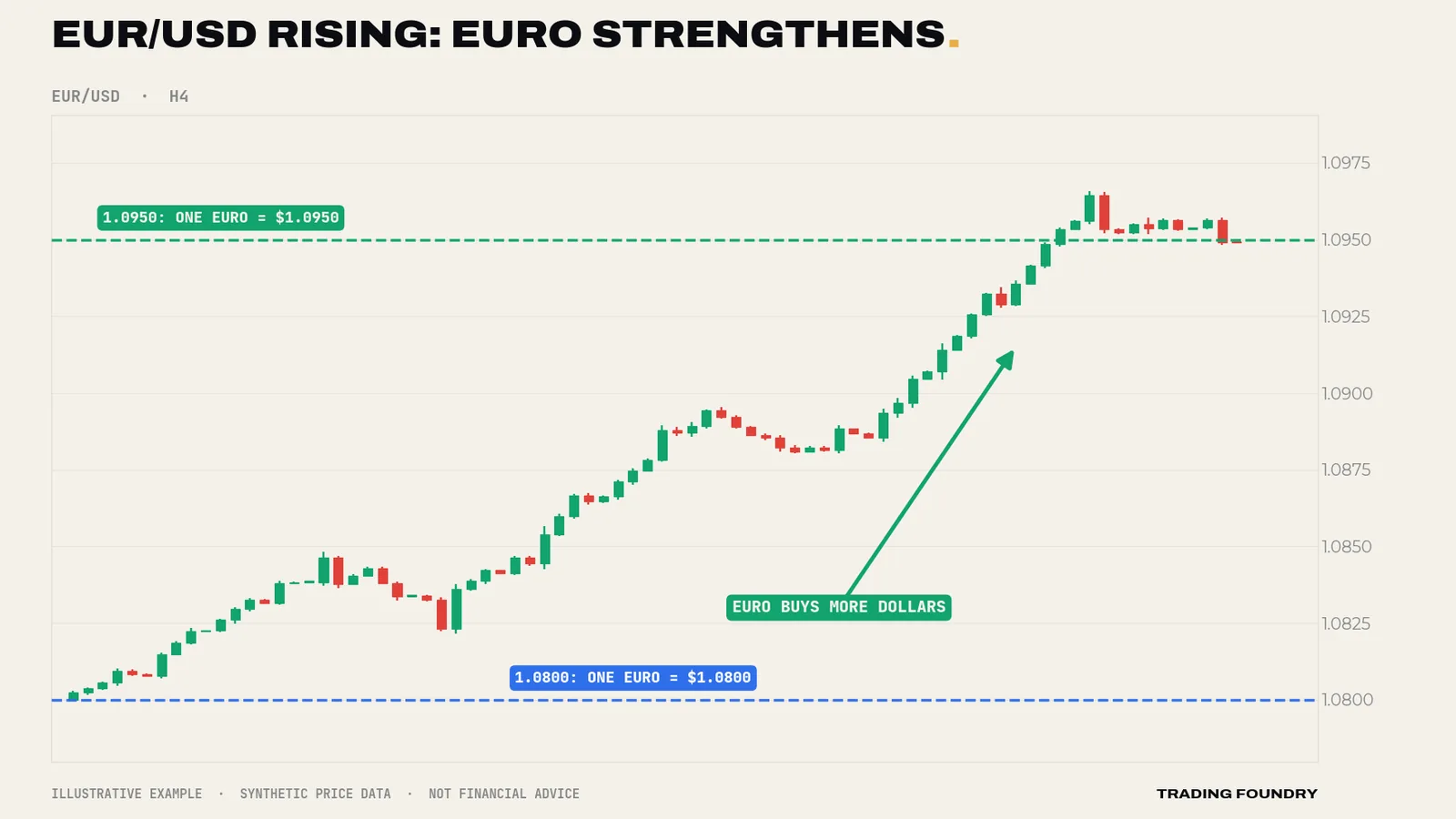
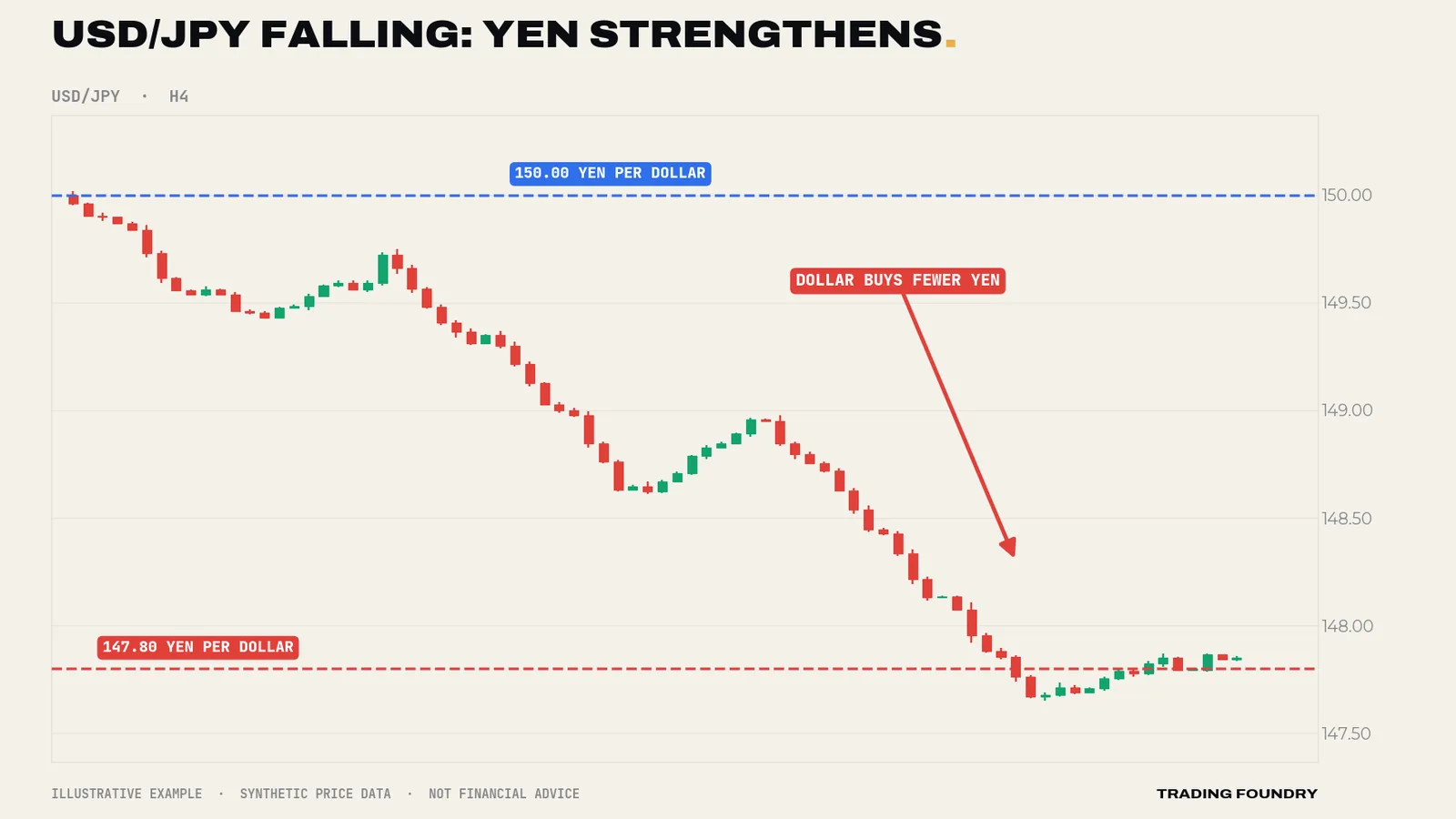
Here is the part that trips people up. The same economic story can make one chart go up and another go down, depending on which currency is written first.
Why exchange rates move
Currencies are priced by supply and demand like anything else. Demand for a currency rises when people need more of it: to buy that country's goods, invest in its companies, or hold its bonds. Some of the biggest, most persistent drivers are:
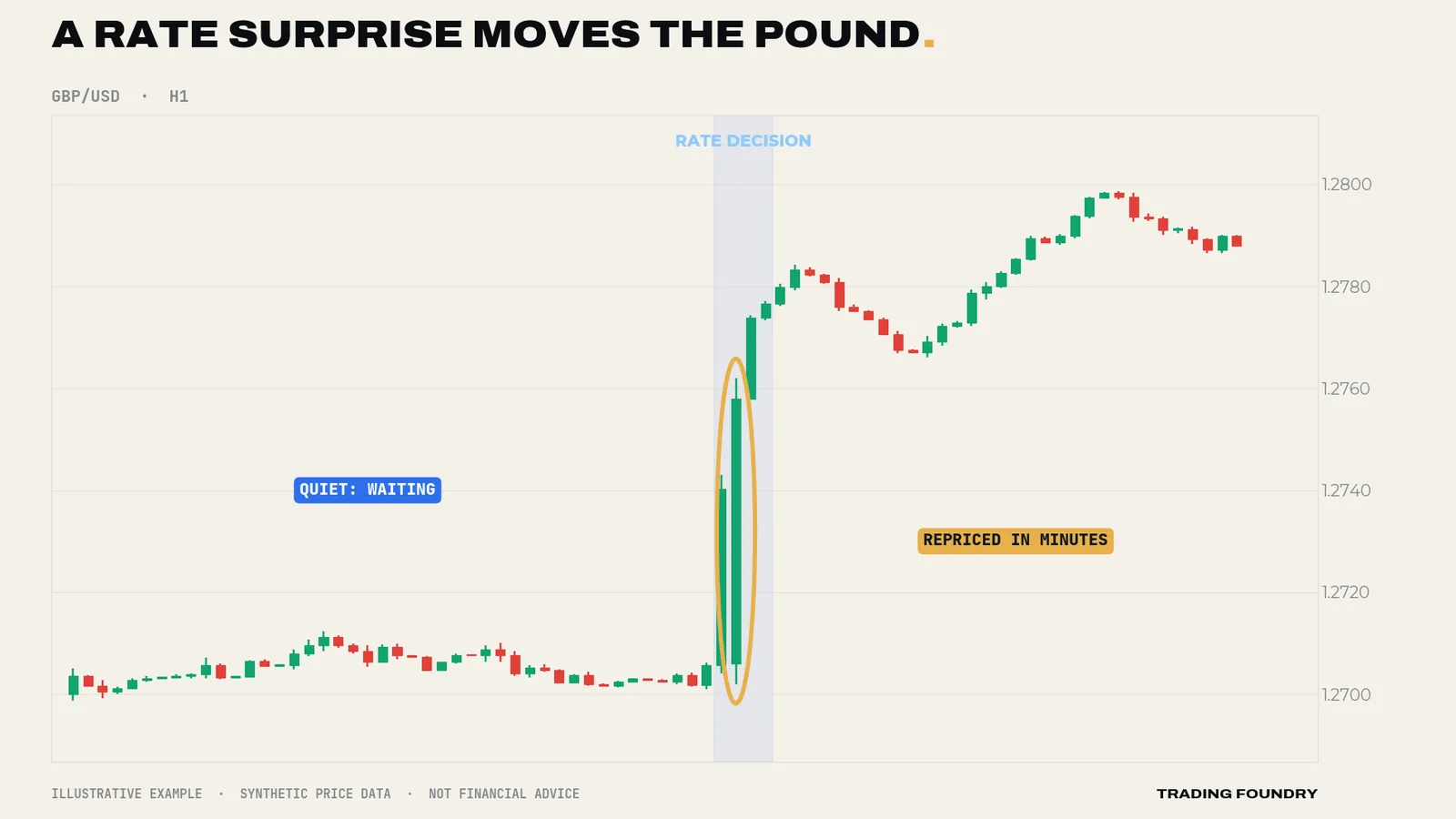
- Interest rates. Money tends to flow towards currencies that pay a higher return for holding them. When a central bank such as the Bank of England, the European Central Bank or the US Federal Reserve raises or cuts rates — or even hints that it might — its currency often moves sharply.
- Economic data. Employment, inflation and growth figures change expectations about future interest rates, so they move currencies too. The monthly US jobs report is a famous example.
- Trade and capital flows. A country that exports heavily, or attracts lots of foreign investment, sees steady demand for its currency.
- Risk appetite. In nervous markets, money often moves towards currencies seen as safe places to park it; in confident markets, it flows back out.
You do not need to forecast any of this to trade, and this course does not ask you to. But you do need to know that these events exist, because they are the moments when prices jump, costs widen and beginners get hurt. We will mark them on charts throughout the course.
Who trades forex
There is no single forex exchange with a trading floor. Forex is an over-the-counter market: a global network of banks, brokers and electronic platforms dealing with each other directly. Roughly, the participants look like this.
Banks and dealers. The big international banks quote prices to each other and to their clients all day, and they handle the bulk of the volume. They are not, mostly, betting on direction. They make money from the gap between the price they buy at and the price they sell at, and from serving clients.
Businesses. Companies that buy or sell abroad convert currencies to pay bills and bring home revenue. Many also hedge — lock in exchange rates in advance — so that a currency move does not wreck their profit margins. Their trades are driven by business needs, not by charts.
Investment funds. Pension funds, asset managers and hedge funds move money between countries to buy shares and bonds, and some trade currencies directly as an investment. Their positions can be very large and held for months.
Central banks. They set interest rates and occasionally buy or sell their own currency directly. They are not trying to make a trading profit; they are trying to run an economy.
Retail traders. That is you. Individuals trading through an online broker, usually with small accounts relative to everyone above. Retail traders are a small slice of the total volume.
This matters for one practical reason: you are not the market's main character. Price will not wait for you, will not notice your stop, and does not owe you a trend. Your job is not to outsmart banks. It is to find situations where the odds lean slightly your way, risk a small and fixed amount on each, and survive long enough for that slight lean to matter. Most of this course is about the "small, fixed amount" and "survive" parts, because those are what beginners neglect.
How a retail trader actually trades
When you open an account with a retail broker and click "buy" on EUR/USD, you are not usually exchanging euros for dollars that land in a bank account. In most cases you are entering a contract whose value tracks the exchange rate. In the UK this is often a CFD (contract for difference) or a spread bet; elsewhere it is commonly a margin forex account. The details vary by country and broker, but the effect is the same: if the price moves your way, the contract gains value; if it moves against you, it loses value, and the gain or loss is settled in your account currency.
Three features of this set-up will come up again and again:
- You can profit from falling prices as easily as rising ones, by selling first. That is called going short, and it is covered in Lesson 4.
- You do not need the full value of the trade in your account. The broker lets you control a large position with a small deposit called margin. This is leverage, and it is the single most dangerous tool a beginner is given. Lesson 4 again.
- Every trade has a cost — at minimum the spread between the buying and selling price. Lesson 3 shows you how to measure it.
A word on regulators. In the UK, the Financial Conduct Authority regulates brokers offering these products, and you can check a firm's registration on its public register. Many other countries have equivalent bodies. A broker you cannot find on a proper regulator's register is a broker to walk away from. Regulators also require brokers to publish the percentage of retail accounts that lose money on these products, and those figures are consistently high. Read them. They are not there to scare you; they are there because they are true.
A practice drill before we start
Before we teach you anything else, here is a first look at the kind of judgement this course builds. You do not need any technical knowledge to answer it — only common sense about what you have just read.
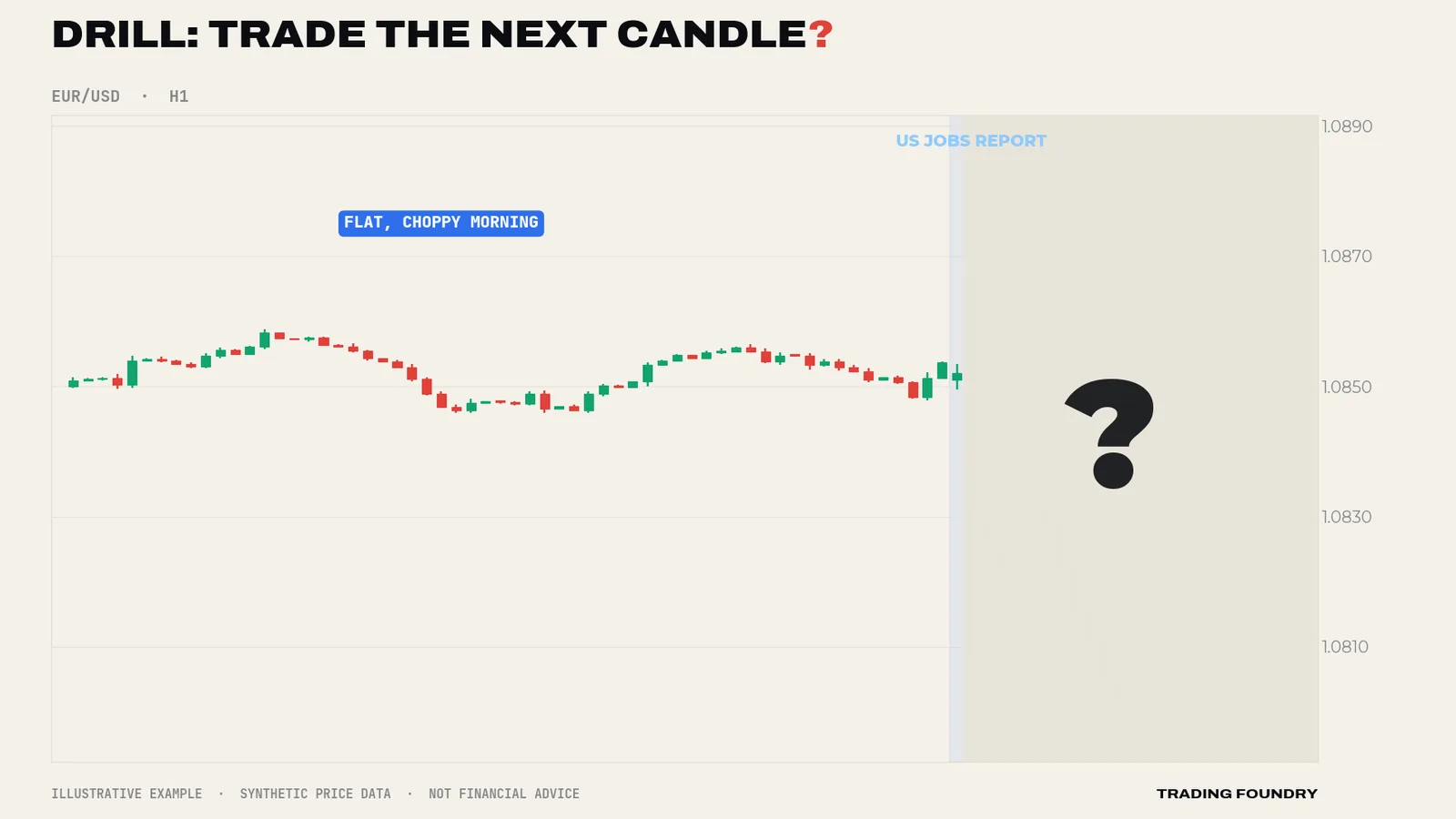
No trade. The scheduled US jobs report is due on the next candle. The morning gave no direction at all, and the next candle swings roughly 70 pips from high to low — up first, then sharply down — before price settles lower. A beginner buying or selling just before the release is gambling on the coin flip, at the moment when costs are widest and stops can fill well beyond their level. Knowing when not to trade is the first skill.
Going deeper
How big is "big"? Industry surveys put global forex turnover at several trillion dollars a day, with the US dollar on one side of the large majority of trades. The practical consequences for you are liquidity and tight costs on the major pairs during busy hours — and the fact that no individual retail trader can move the price. Liquidity is not constant, though. It thins out in the gap between the New York close and the Asian open, around holidays and immediately before major news, and costs widen accordingly (Lessons 3 and 5).
Who is on the other side of your trade? With a retail broker, your trade's counterparty is usually the broker itself. Some brokers pass client orders on to banks and liquidity providers; others take the other side internally and manage the overall exposure. Neither model is automatically sinister — regulated brokers must treat client orders fairly and keep client money segregated — but it is worth understanding what your broker's model is and how it makes money (spread, commission, or both). Read the order execution policy. It is dull, and it is your money.
Rolling positions and swap. Because spot currency trades technically settle two days later, positions held past the daily roll-over time are charged or credited an overnight financing amount, called swap or rollover, based on the interest rate difference between the two currencies plus a broker charge. For short-term traders it is small; for positions held for weeks it becomes a real cost, and on some pairs it is charged in both directions. We cover it with the other costs in Lesson 3.
The honest picture. Retail forex is legal, regulated and accessible, and it is also a market where most retail accounts lose money. The main reasons are not mysterious: too much leverage, no fixed risk per trade, trading around news and in quiet hours, and treating each trade as a test of being right. Every one of those is fixable with knowledge and discipline, and that is what this course is for. Nothing here promises profit. What it can do is stop you losing money for avoidable reasons.
Summary
- Forex is the global market for exchanging one currency for another, quoted in pairs such as EUR/USD.
- A rising chart means the first currency is strengthening against the second; a falling chart means it is weakening.
- Prices move on supply and demand, driven largely by interest rates, economic data, capital flows and risk appetite.
- Banks, businesses, funds and central banks dominate volume; retail traders are a small slice and do not move the price.
- Retail traders usually trade contracts that track the rate, with leverage and costs — both of which this course teaches you to control.
Quick quiz.
Education only, not financial advice. Charts are illustrative training examples using synthetic price data, not real market history or results.