 TRADING FOUNDRY
Spreads and Costs — What Every Trade Really Costs You.
Read the bid and ask, measure a trade's full cost — spread, commission, swap and slippage — and judge whether that cost is small enough relative to your stop to be worth paying.
Nobody runs a forex broker for fun. Every time you open and close a trade, you pay for the privilege. The fee is rarely presented as a bill; it is built into the prices you see, charged quietly per lot, or added overnight. Because it is quiet, beginners ignore it — and then wonder why a strategy that "should" break even keeps slowly bleeding.
This lesson makes the costs visible. You will learn where the spread comes from, how commission and swap work, why slippage exists, and — most usefully — how to judge whether a trade's cost is a rounding error or a serious handicap. That last judgement is about proportion, and it shapes which timeframes and stop sizes are realistic for you.
All prices and costs in this lesson are illustrative. They are in a realistic range for major pairs at a regulated retail broker, but yours will differ. Part of the job is measuring your own.
Two prices: the bid and the ask
At any moment, your platform shows two prices for each pair:
- The bid — the price at which you can sell.
- The ask (or offer) — the price at which you can buy.
The ask is always higher than the bid. The gap between them is the spread, measured in pips. If EUR/USD shows 1.08500 bid and 1.08512 ask, the spread is 0.00012, or 1.2 pips.
That gap is the dealer's margin. Think of the bureau de change at an airport: it buys your pounds at one rate and sells them back at a worse one, and the difference is how it pays the rent. A forex broker does the same thing, only with a far smaller gap.
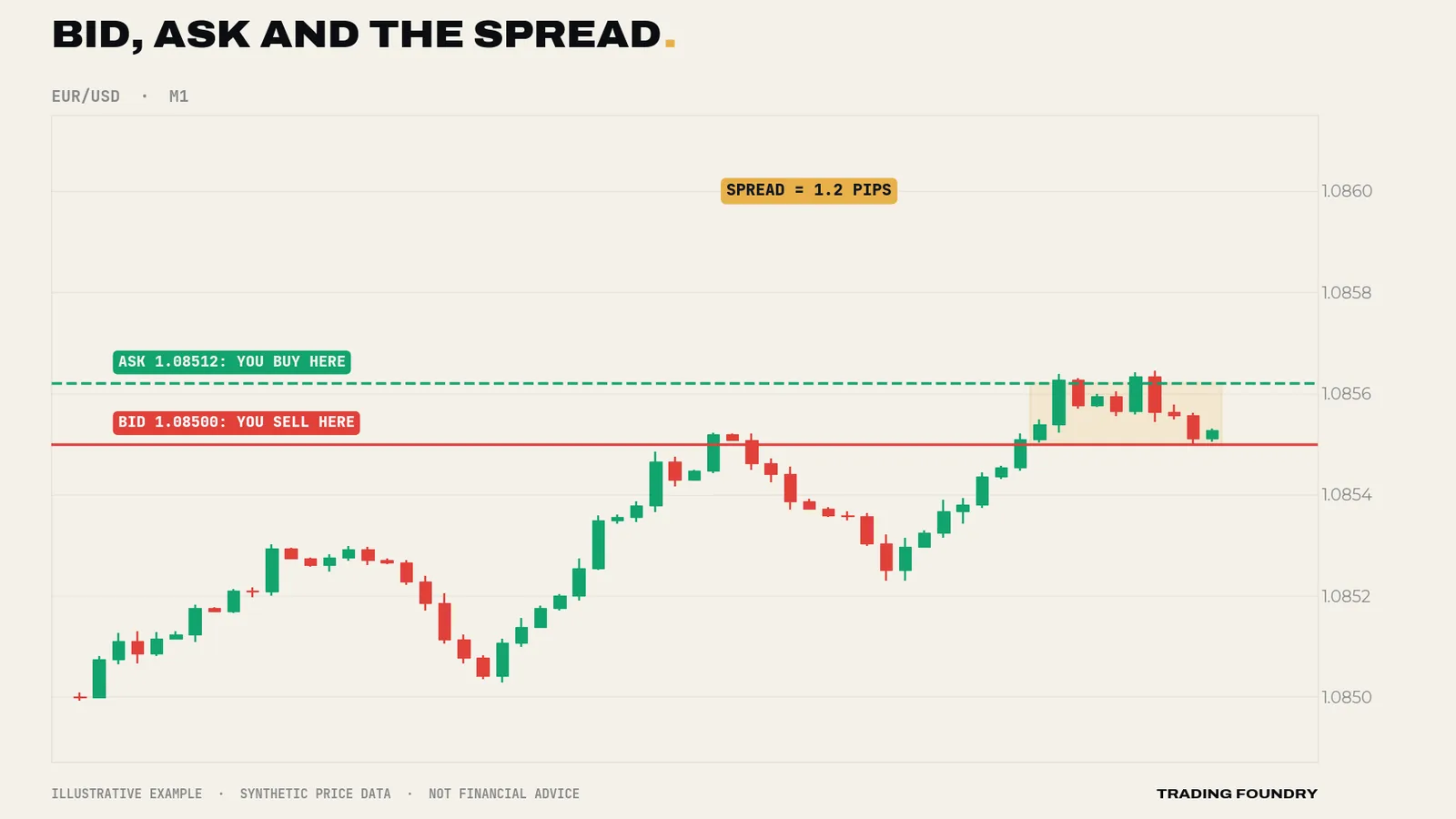
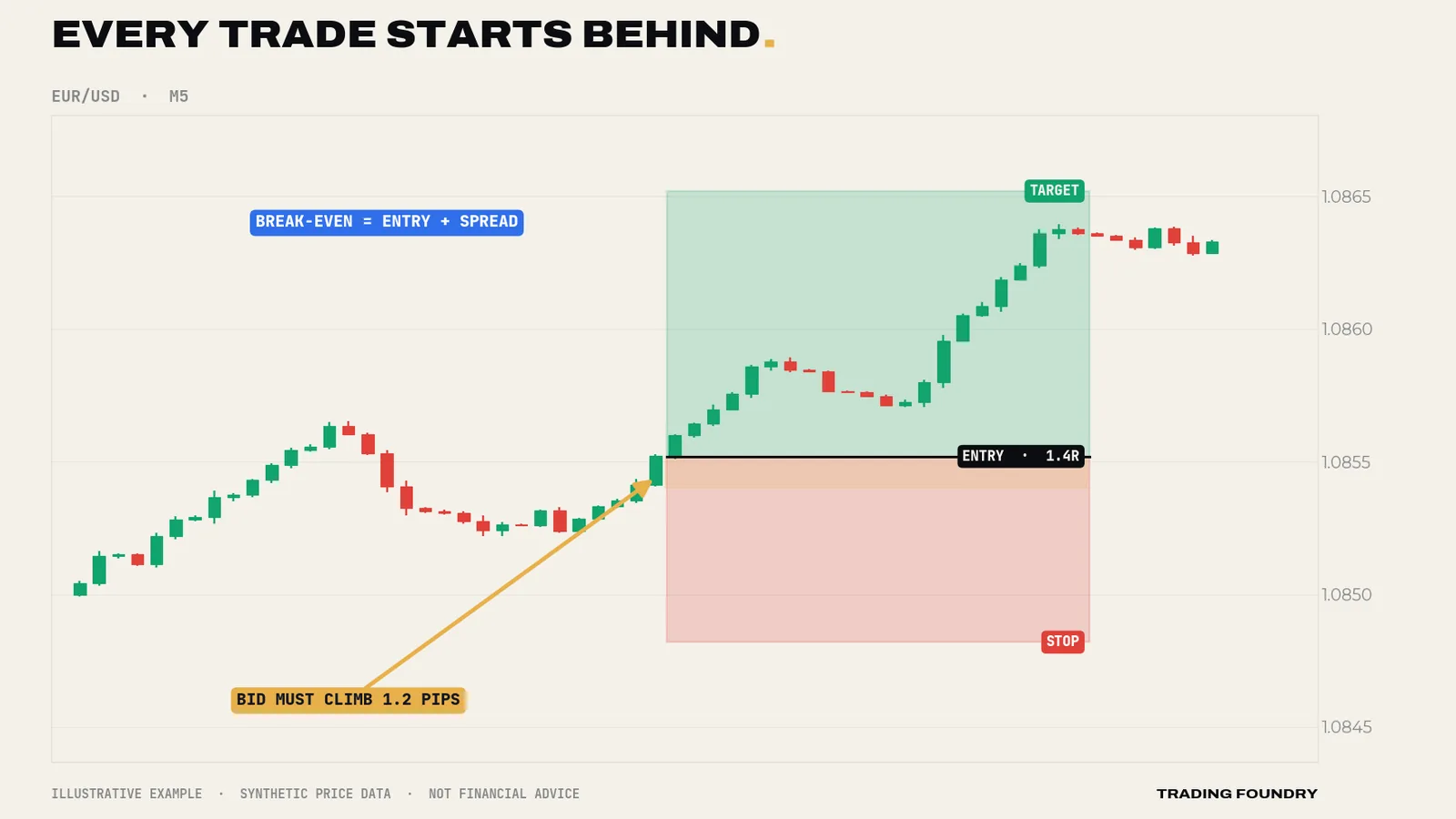
A practical consequence: every trade starts slightly in the red. Buy at the ask, and if you closed immediately you would sell at the bid — 1.2 pips lower. Price has to move in your favour by at least the spread just to get back to zero.
Spread accounts and commission accounts
Brokers charge in one of two broad ways.
Spread-only (often called "standard") accounts. No separate fee; the broker's charge is built into a wider spread. On EUR/USD in busy hours you might see something like 0.8–1.5 pips.
Raw-spread or commission accounts. The spread is much tighter — perhaps 0.1–0.3 pips on EUR/USD in busy hours — but you pay a commission per lot. A common structure is around $7 per standard lot per round turn (opening and closing). On EUR/USD, where a pip on one lot is $10, $7 is 0.7 pips.
Add the parts to get your all-in round-trip cost:
- Standard account: 1.2-pip spread + nothing = 1.2 pips.
- Raw account: 0.2-pip spread + 0.7-pip commission = 0.9 pips.
The cheapest account type depends on how often and how large you trade, so compare them on this all-in number, not on the headline spread.
Spreads are not fixed
The spread changes all day. It is tightest when the most banks and dealers are active — the London session and the London–New York overlap — and widest when they are not:
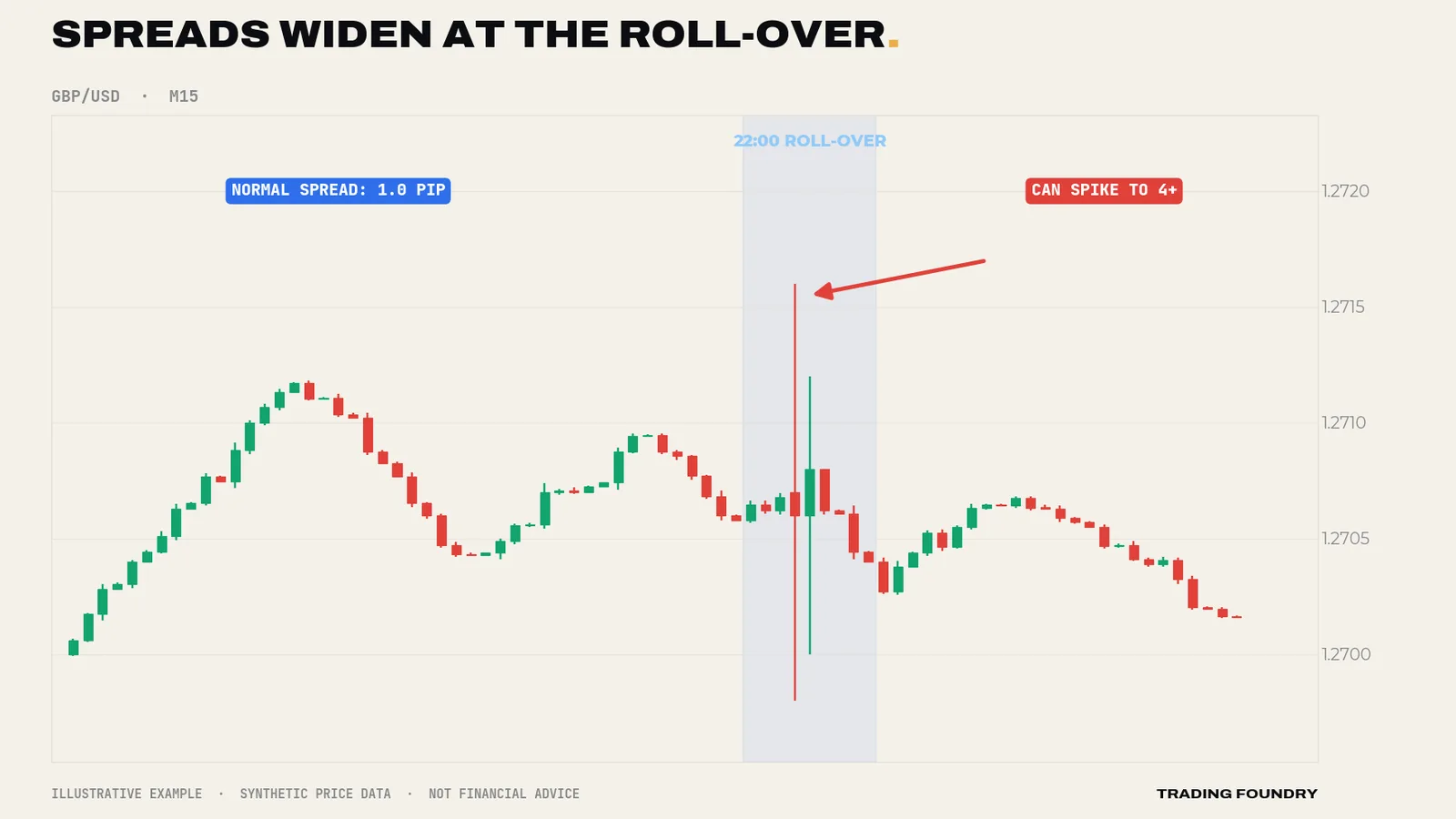
- Around the daily roll-over (around 22:00 UK time, depending on daylight saving), when liquidity is thin and dealers reset positions. Spreads can briefly widen to several times normal.
- Before and during major news, when dealers pull back and prices jump.
- On Monday's open and before weekends or holidays.
- On less-traded pairs, all the time.
Swap: the overnight cost
If you hold a position past the daily roll-over, it is charged or credited swap (also called rollover or overnight financing). Swap is based on the difference between the interest rates of the two currencies, minus a broker charge, and it is applied for each night held. Many brokers apply three nights' worth on one weekday — commonly Wednesday — to cover the weekend.
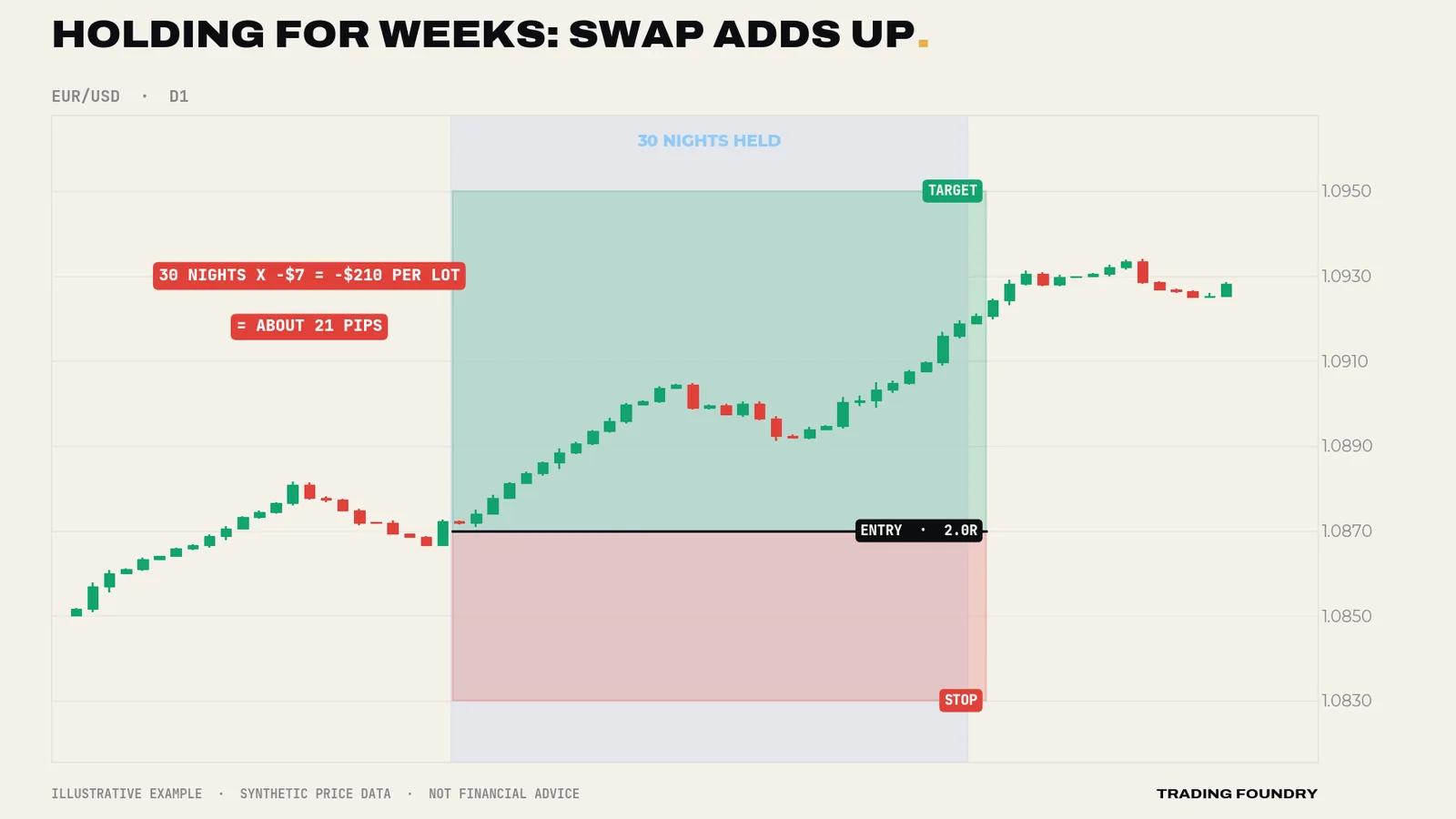
Swap can be positive or negative depending on direction, but after the broker's charge it is often negative in both directions on some pairs. For a trade held a few hours, ignore it. For a trade held for weeks, it adds up. A position paying an illustrative −$7 per lot per night costs $210 per lot over thirty nights — the equivalent of 21 pips on EUR/USD. Your platform shows the current swap rates in each symbol's specification.
Slippage: the cost nobody quotes
Slippage is the difference between the price you asked for and the price you got. A market order fills at the best available price at the moment it reaches the market; if price is moving fast, that can be worse than the price you saw when you clicked. A stop-loss order, once triggered, also becomes a market order — so in a fast move it can fill beyond your stop level.
Slippage is usually small in calm, liquid conditions and can be large around news and opens. It can occasionally be in your favour. You only learn your typical slippage by logging the price you intended and the price you were filled at, on every trade.
The judgement that matters: cost as a share of your stop
A one-pip cost means nothing on its own. What matters is its size relative to your stop, because the stop is what you are risking.
- 1.2-pip cost on a 40-pip stop = 3% of your risk. A rounding error.
- 1.2-pip cost on a 10-pip stop = 12% of your risk. Noticeable.
- 1.2-pip cost on a 5-pip stop = 24% of your risk. A heavy handicap, paid on every trade.
This is why the smallest timeframes, with the tightest stops, are the hardest place for a beginner to make the arithmetic work. A simple guard rail for this course: if your all-in cost is more than about a fifth of your stop, the trade is too expensive. Widen the stop (and reduce the size — Lesson 11), move to a higher timeframe, or skip it.
Going deeper
Measure, do not guess. For two weeks, at the times you intend to trade, note the spread on your chosen pair every 15 minutes, and log intended versus filled price on any demo orders. Take a bad-but-normal figure (around the 80th percentile, not the average) as your planning cost. Averages flatter you, because spreads are widest exactly when markets move.
Commission converts by pair. $7 per lot is 0.7 pips on EUR/USD and GBP/USD, where a pip on a lot is $10. On USD/JPY at 150.00, a pip on a lot is about $6.67, so $7 is about 1.05 pips. Convert before comparing.
Costs and the break-even win rate. If you risk S pips to make T pips and pay C pips per round trip, a winner nets T − C and a loser costs S + C. The win rate you need just to break even is (S + C) ÷ (S + T). With a 20-pip stop, 40-pip target and 1.2-pip cost: 21.2 ÷ 60 = 35.3%, against 33.3% with no costs. With a 5-pip stop and 10-pip target and the same cost: 6.2 ÷ 15 = 41.3%. Same reward-to-risk, same cost in pips — but the smaller trade needs eight more winners in every hundred just to stand still. These figures are arithmetic, not predictions of any strategy's results.
Guaranteed stops. Some brokers offer guaranteed stop-loss orders that cannot slip, for an extra fee charged when they are used. They can be worth it for trades held over weekends or through known events. Read the terms.
- Know your all-in round-trip cost (spread + commission + typical slippage) in pips for your pair and hours
- If the all-in cost is more than about a fifth of your stop, do not take the trade as planned
- Avoid opening trades in the hour around the daily roll-over and immediately before major scheduled news
- Check the swap rate before planning to hold a position for more than a few days
Summary
- You buy at the ask and sell at the bid; the gap is the spread, and every trade starts behind by that amount.
- Commission accounts swap a wider spread for a fee per lot; compare accounts on the all-in cost.
- Spreads widen around the roll-over, news, opens and on thin pairs; slippage is worst at the same moments.
- Swap is charged nightly on held positions and becomes significant over weeks.
- Judge cost as a share of the stop: above roughly a fifth, the trade is too expensive.
Quick quiz.
Education only, not financial advice. Charts are illustrative training examples using synthetic price data, not real market history or results.