 TRADING FOUNDRY
Long, Short, Leverage and Margin — and Why Leverage Is Dangerous.
Explain how buying and selling make money in either direction, calculate the margin a position uses, and measure how leverage turns small price moves into large account swings.
Two features make retail forex very different from buying shares in an ISA. You can make or lose money as easily when prices fall as when they rise. And you can control a position many times larger than the money in your account. The first is genuinely useful. The second is the main reason beginners lose money quickly.
This lesson explains both properly: what going long and short actually means, what margin is, what leverage really does to the numbers, and what happens when an over-leveraged account runs out of room. The lesson ends with a rule that should stay with you for your whole trading life: your broker's leverage limit is not your risk limit. You decide risk with your stop and your position size. Leverage merely allows it.
All figures are illustrative and assume a pound account, a GBP/USD rate of 1.2700, and the 30:1 maximum leverage that UK and EU regulators currently allow retail clients on major pairs. Check your own broker's limits.
Going long and going short
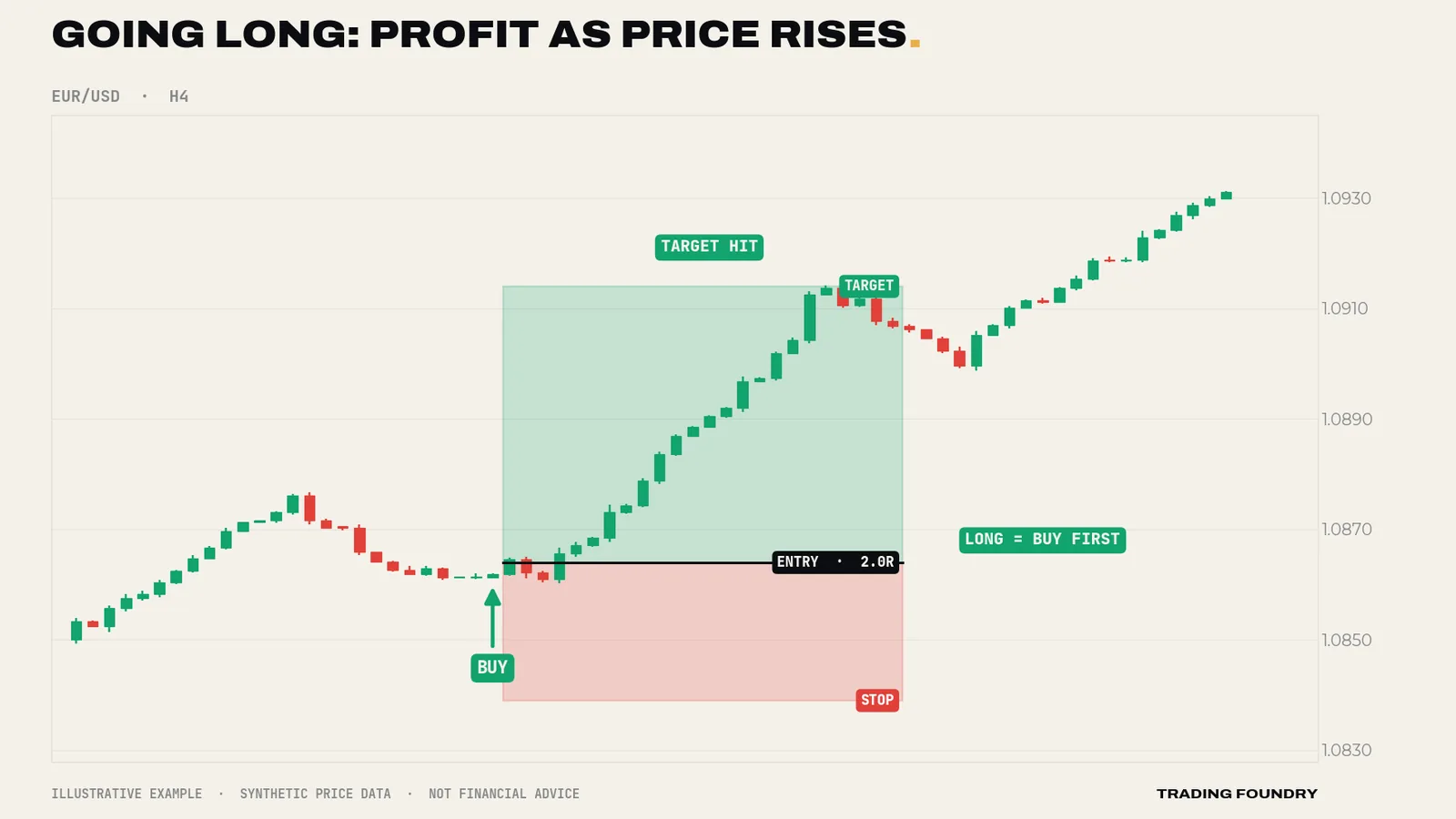
Going long means buying a pair. You profit if it rises. Buy EUR/USD at 1.0850, sell it later at 1.0900, and you have made 50 pips.
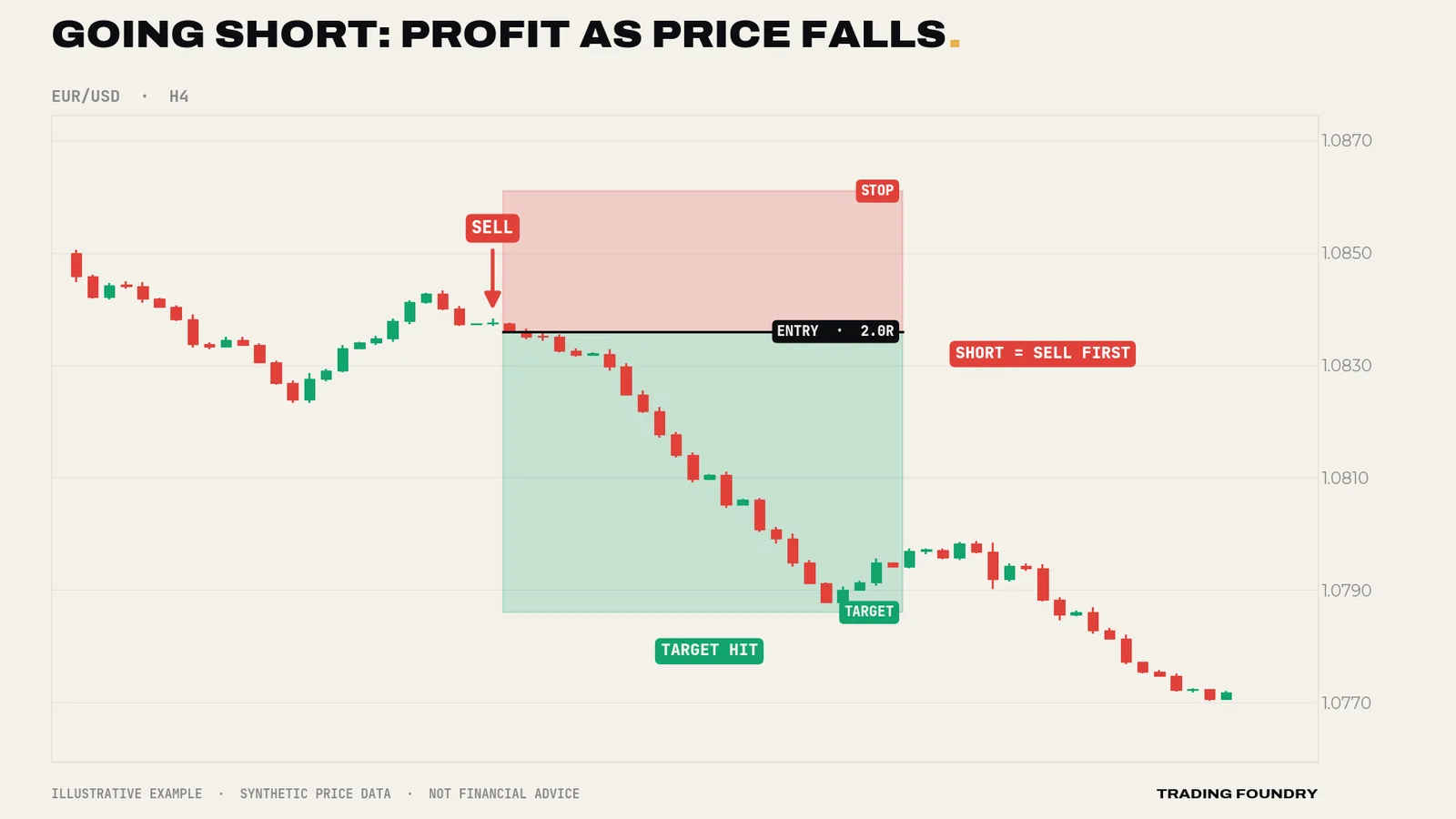
Going short means selling a pair you do not already own, hoping to buy it back cheaper later. Sell EUR/USD at 1.0850, buy it back at 1.0800, and you have made 50 pips. Because a currency pair is always one currency against another, selling EUR/USD is simply buying dollars against euros. There is nothing exotic about it; it is just as normal as buying.
What margin is
When you open a leveraged position, your broker does not lend you the full amount in a way you ever see. Instead, it sets aside part of your balance as a deposit to cover potential losses. That deposit is called margin.
With 30:1 maximum leverage, the margin required is 1/30 of the position's value, or about 3.33%.
Worked example:
- You buy 0.50 lots of EUR/USD at 1.0850. That is €50,000.
- In dollars: €50,000 × 1.0850 = $54,250.
- In pounds: $54,250 ÷ 1.27 = about £42,717. That is the size of the position — its notional value.
- Margin at 3.33%: £42,717 ÷ 30 = about £1,424.
So on a £2,000 account, a 0.50-lot trade "uses" £1,424 of margin and leaves about £576 of free margin — the room you have before the broker starts to worry. Margin is not a fee. It is returned when you close. But it limits how big a position you can open, and it sets the point at which the broker will close your trades for you.
What leverage really does
The headline "30:1 leverage" describes the maximum. What matters is your effective leverage: the size of your positions divided by your account equity.
In the example above, a £42,717 position on a £2,000 account is effective leverage of about 21:1. The arithmetic of that:
- 0.50 lots on EUR/USD is $5 per pip, or about £3.94 per pip.
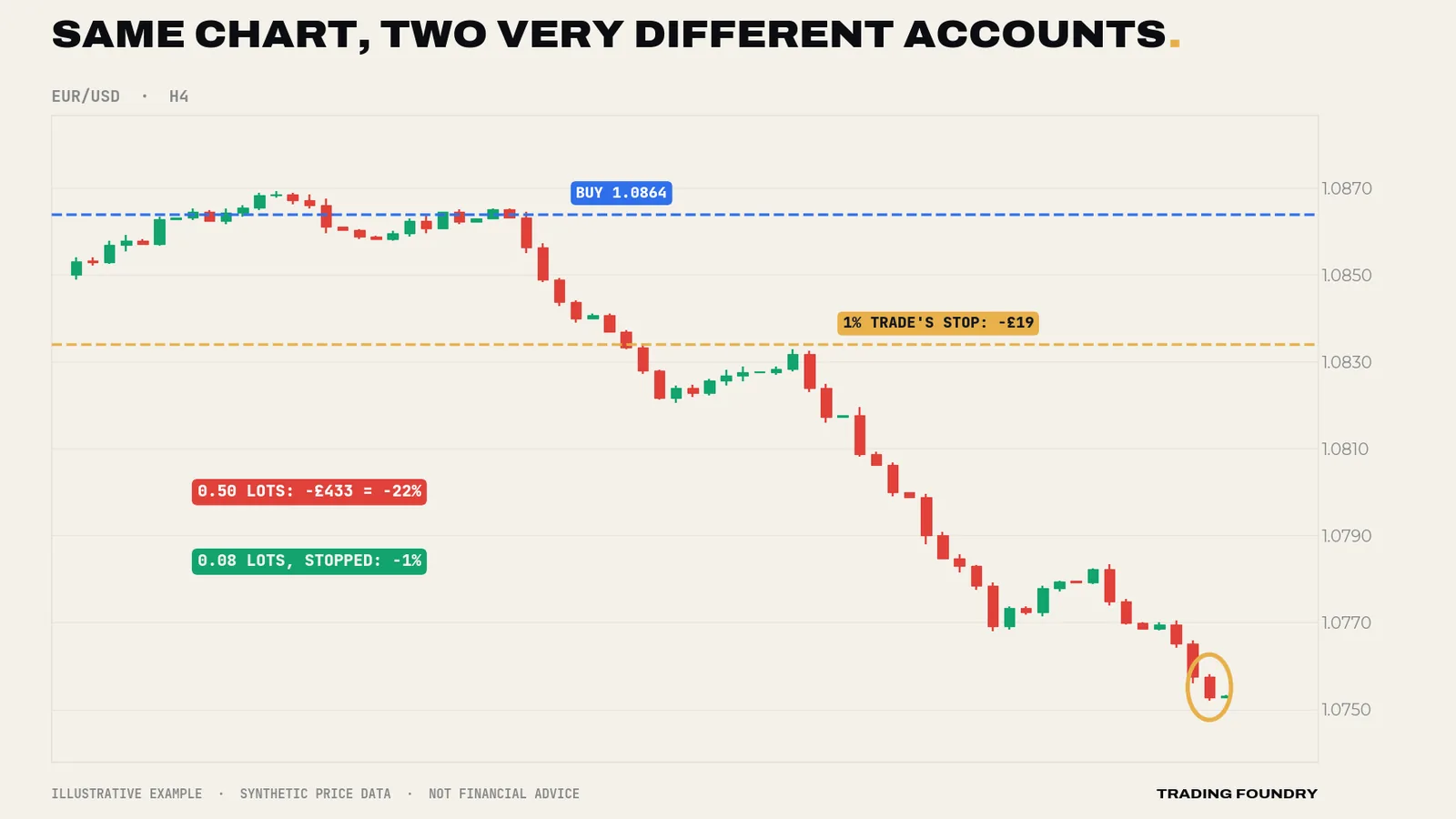
- A 50-pip move against you — a perfectly ordinary day on EUR/USD — costs about £197, or 10% of the account.
- A 100-pip move costs about £394, or 20%.
Now compare a sensibly sized trade on the same account. Suppose the chart says the stop belongs 30 pips away, and you decide to risk 1% of the account (£20) if it is hit. That works out at about 0.08 lots (the method is in Lesson 11): roughly £0.63 per pip, a notional value of about £6,835, and effective leverage of about 3.4:1. A 100-pip move against that position would cost £63 — but it never gets the chance, because the stop closes it at a £19 loss.
Leverage is often sold as "control a large position with a small deposit". The more honest description is: leverage multiplies the effect of every pip on your account, in both directions. It does not change the chart. It does not change your odds. It changes how hard each pip hits.
Margin calls and stop-outs
As an open position loses money, your equity (balance plus or minus open profit and loss) falls, while the margin used stays the same. The ratio between them is your margin level:
Margin level = equity ÷ margin used × 100%
Brokers act at set thresholds. Typically you get a margin call warning when the margin level falls to around 100%, and under UK and EU rules for retail clients, the broker must start closing your positions — a stop-out — when it falls to 50%.
Back to the over-leveraged 0.50-lot trade on £2,000, with £1,424 margin used:
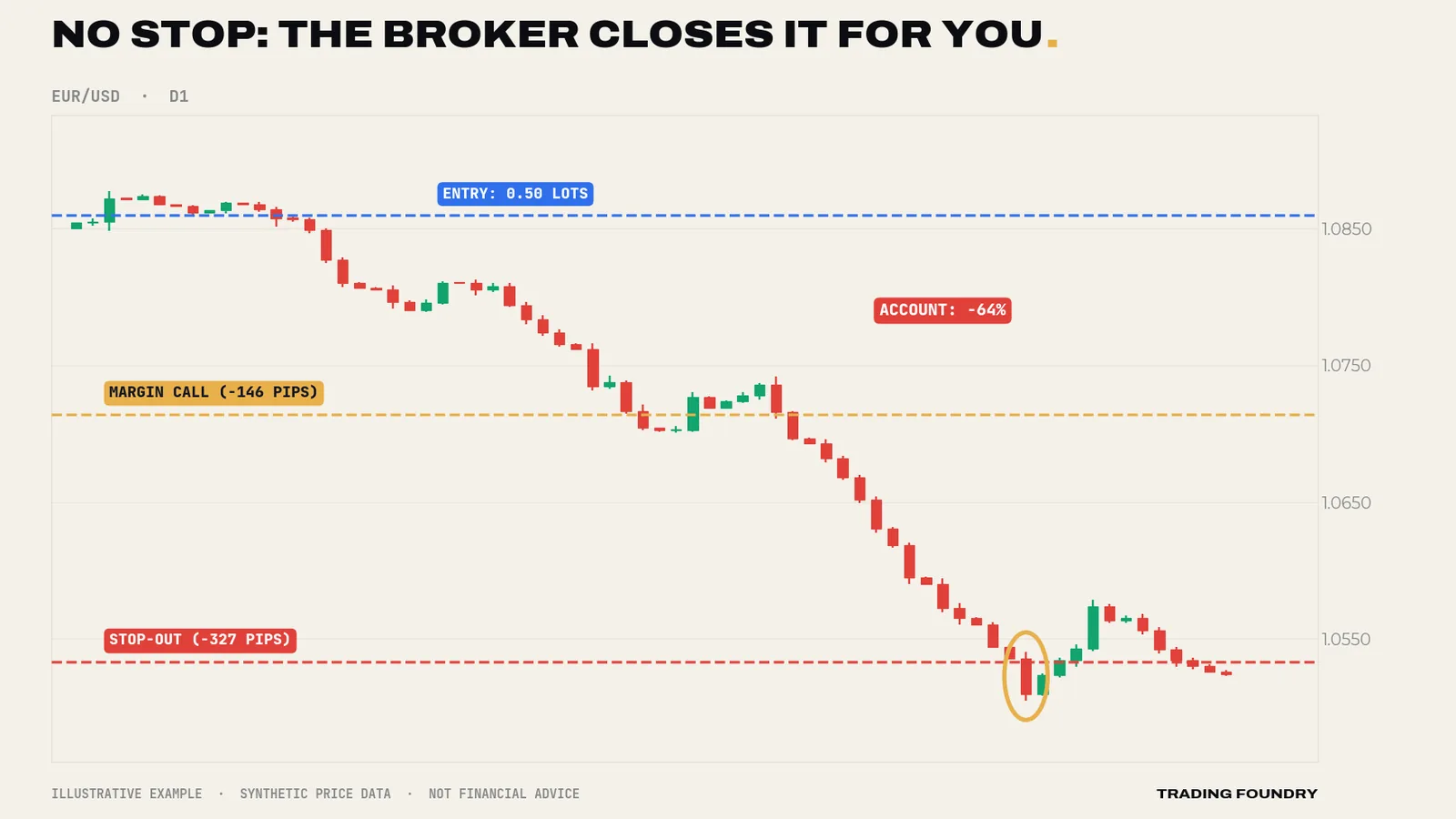
- Margin call at 100%: equity £1,424 → a loss of about £576 → about 146 pips against you.
- Stop-out at 50%: equity £712 → a loss of about £1,288 → about 327 pips against you.
A 327-pip move in EUR/USD is not rare over a couple of weeks. And a stop-out does not close the position at a nice price; it closes it wherever the market is when the threshold is breached. You would lose around 64% of the account on one trade that never had a planned stop.
Negative balance protection and gaps
Under UK and EU rules, retail clients have negative balance protection: you cannot lose more than the money in your account. That is a safety net, not a strategy. Prices can gap — jump from one level to another without trading in between — over weekends and around big news. A gap can carry price straight through your stop, and your order fills at the next available price. Small, sensibly sized positions shrug gaps off. Over-leveraged ones do not.
Going deeper
Why regulators capped leverage. Retail leverage limits in the UK and EU (30:1 on major pairs, 20:1 on minor pairs and gold, lower on more volatile instruments) were introduced because retail losses on high-leverage products were persistently large. Some offshore brokers still offer 500:1 or more. Higher maximum leverage does not give you an edge; it gives you a bigger rope.
Leverage is an output, not an input. Professionals rarely think about leverage directly. They decide risk per trade (say 0.5–1%), find the stop on the chart, calculate the position size that makes the stop cost exactly that, and then check the resulting margin is comfortably affordable. Effective leverage drops out of that process — usually low single figures for a single trade. If you ever find yourself thinking "how much leverage should I use?", rephrase it to "how much am I prepared to lose if this is wrong?".
Correlated positions add up. Two trades that are both "short the dollar" — say long EUR/USD and long GBP/USD — behave much like one larger trade. Each may be sized at 1%, but a dollar rally can hit both stops together. For beginners, the simplest rule is one open trade at a time.
The maths of recovery. Losses are harder to recover than they look. Lose 10% and you need 11% to get back. Lose 20% and you need 25%. Lose 50% and you need 100%. Lose 64%, as in the stop-out example, and you need about 178%. Small fixed risk keeps you in the zone where recovery is realistic.
- Every trade has a stop placed at the moment of entry; margin rules are never your stop
- Position size is calculated from the stop and a fixed risk per trade, not from available margin
- Keep margin used comfortably below half of your account equity
- One open trade at a time while learning
Summary
- Long profits from rising prices, short from falling; the stop always sits where the idea is proven wrong.
- Margin is a deposit set aside to cover losses; at 30:1 it is about 3.33% of the position's value.
- Effective leverage — position size divided by equity — is what decides how hard each pip hits your account.
- Margin calls and stop-outs close over-leveraged trades at the worst moment; a planned stop and sensible size prevent both.
- Your broker's leverage limit is not your risk limit. You set risk with your stop and your size.
Quick quiz.
Education only, not financial advice. Charts are illustrative training examples using synthetic price data, not real market history or results.